Author: Jan Gebauer

  • The unbearable weight of freedom

    I am really struggling with the question “Am I on track to get a remote job in five years?” But is this question even relevant? Is it actionable? Is it useful? No, no, no.

    I have no clue what the market will be like in five years. If AI boosters get their way, it might not even matter. If AI middle-of-the-round people get their way, I might be using an AI agent, so getting up to speed and productive might be just fine, as long as I keep doing something. If AI skeptics get their way, it might be a struggle to demonstrate transferable skills but if it is anything like the 2010s, it might not be the case?

    In all of these scenarios, I am probably fine overall? And maybe remoteness is correlated with years of experience more than anything else? So many questions, impossible to answer.

    So what if it’s less about the future and more about the present? What if I am just reacting to the situation at my current job? I like what I got, the company is what I wanted for the past few years. The pay is probably the best I’ll ever have in this neck of the woods.

    But I gotta say, I am doing something different than was advertised, I have to plan my home-office days carefully and when the trains are not running, I might be out of luck.

    If I try to separate my feelings on work and hobbies? Surely, it must be possible. And once I do, I cleave the situation into the horrible freedoms. On the one, hand, I can be elated that I have my own choice of what I do in my spare time, as long as it brings me joy. And that’s a good thing. On the other hand, I was free to choose this job and now I live with the consequences.

    Freedom? Free doom.

    Like I said, the consequences are good, actually. But I why can’t things be perfect?

    Maybe the realisation that my anxiety for the future is tightly coupled to my work and entirely separate from my hobbies is enough. What else is there to do? I won’t be changing jobs any time soon, the current situation is too good.
  • Aspirational blogging

    When I blog, I blog aspirationally. I previously wrote an article on my defunct Substack where I professed my love for Go, even though I wasn’t really coding in Go that much1.

    And I have loads of other thoughts like that when I blog. Very much a top-down approach. And I think that’s dishonest of me. I am probably also doing myself a disservice. After all, New Year’s Resolutions don’t work and this is a lot similar similar.

    Per chance I should leave aspiration to my Quest journal. | can say whatever non-sense I want over there. Here, I would like to be more helpful. Or maybe I should have a small widget as a window to my aspirations.

    Anyway, writing aspirationally really bottlenecks my output and that’s no bueno. Sure, writing more about what I am doing is not that enjoyable as I am either in the middle of it, so it’s difficult to put into words, or beyond it, in which case it is boring to talk about.

    It is indeed ironic to say that I will aspire not to write aspirationally but constraints are good.

    1. If I focus on what is, rather what could or should be, my loved languages are clearly Java and TypeScript. I rarely complain when using them and I generally find them acceptable to use. Yes, I wish Java and Node had a more Go/Bun-like tooling but it’s fine, bro, trust me, it’s fine. ↩︎

  • Poking yourself in the eye

    You know how you really like something, or rather the idea of it, and so you keep coming back to it but it always either hurts or just annoys you and so you give up, only to repeat this again in a vicious cycle?

    No? Just me, okay then.

    Anyway, that’s how I feel about Go.

    I really like the simplicity and the look. But why is it so cursed? Maybe my mind is thoroughly rotten by the dual menace of OOP and Java but why is Go like that?

    I mean honestly, just look at the language. People have been hating on Java for having too much boiler plate. Yes, “private static final String FOOBAR” is quite the boiler but Go?

    For gains in simplicity, it loses loads in overall productivity. Java has Spring Boot. What does Go have?

    Nothing. Why? Because Go devs are better. Don’t mind the boilerplate packages meant to get your app up and running. Go is made for the reader you see. Every Go dev, who uses a boilerplate package has read through the thing. Trust me, bro, you gotta believe me.

    Anyway, I am sure I’ll return to Go at some point again to poke myself in the eye once more. For web dev, anyway. I don’t really have a quarrel with the language when it comes to other things. In fact, I would love to work with Go at my day job, so that I don’t have to deal with Python’s dependency non-sense.

  • Getting out of the house

    I would like to obtain more power in my career. Starting a business seems like it could do the trick.

    The unfortunate truth is that I have no ideas. Or maybe I have ideas but I don’t come up with new ones fast enough.

    Either way, I think both issues can be solved by getting out of the house. Doing something else than what I do on a daily basis.

    But man, is it hard.

    What’s hard about it is that I have to learn a whole new thing that I am not good at. I normally don’t mind this. I suspect that I don’t mind it because I usually choose something that’s very close to my existing expertise.

    The way it usually goes is that there is something I want to learn (e.g. K3s on ProxMox or WordPress deployment), I sit down to do it, feel resistance and I simply push through. The feelings I have are those of “I can do it but I don’t wanna”.

    I liked the idea of learning a scientific field. I looked up some research groups and their publications. I found a paper1 that made me go “oh this looks cool!”. So I opened it and guess what. “Oh please no, I don’t want to do this.”

    Based on this, one could reasonably assume that the singular bottleneck in getting new ideas is, for me, the willingness to learn a new domain.

    But I suspect that this would be wrong. I have tried to learn a new domain in the past, with much enthusiasm. I tried to create a plugin for Shopify. So where did that go wrong?

    The last thing I want is more stuff. Stuff is neat but how do you get rid of stuff? Marie Kondo sure has some thoughts but what if you buy the wrong stuff? What about the climate change? I could rant on and on about this but you get my point. Me -> Stuff = Bad.

    I didn’t really stick around with the Shopify project. I didn’t want to run my own store and I didn’t care that about merchants. They got some neat things but it’s just not for me.

    So what is for me?

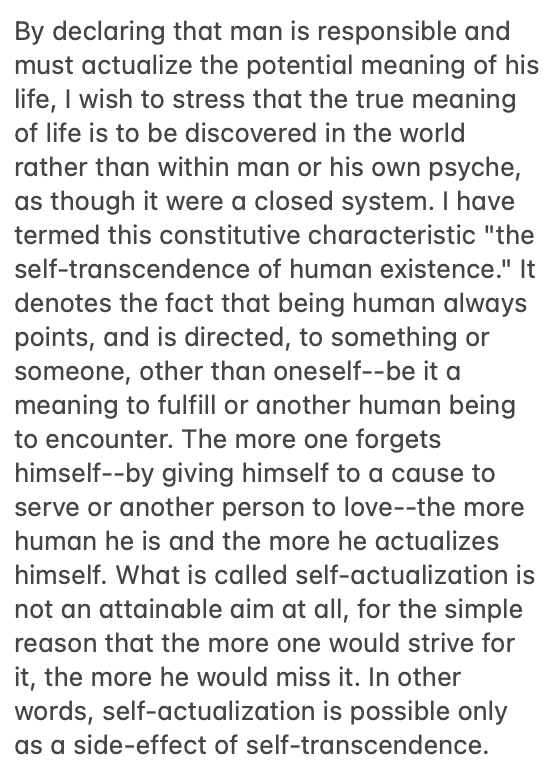
    Unknown source – Viktor Frankl

    I have two very close friends. They are really into Warhammer 40k. I am not. Don’t get me wrong, the whole thing is very cool. War = bad but WAAAGH!? Hell yeah, brother, cheers from Iraq. However, I have so many reservations. First of all, it’s more stuff. And even worse, it’s bulky stuff. You could convince me to go back to Magic: The Gathering. Magic decks easily fit in a backpack. A combat patrol not so much. Moreover, there’s painting. I seriously dislike arts and crafts.

    And yet, here I am, considering whether I should get into W40k or not. I have to really restrain myself from buying the starter pack. After all, my friends are into it and I like my friends. And I might enjoy it for a long time. That’s what happened with Magic and D&D.

    What if I applied this mindset to learning a new domain? Forget learning the thing directly, learn the people first. I always load up on knowledge by reading, I enjoy it but it’s clearly not productive. It doesn’t ignite the spark.

    What if I forced myself to avoid reading broadly about the domain and instead interviewed the experts? Scott Hanselman has a podcast2. He says that inviting people on it is easy because the act of podcasting itself makes it something more than just a chat, even if the end-product isn’t consumed by many. How does Scott find the cool people? Maybe I should just ask him.3

    To get out of the house, I commit to 10 interviews with experts from a domain that I find interesting.

    It doesn’t matter what the domain is. I find accounting, insurance and re-insurance cool. Let’s start there.

    1. Genetic Algorithm-based Control of a Two-Wheeled Self-Balancing Robot –https://link.springer.com/article/10.1007/s10846-025-02236-1 ↩︎
    2. https://www.hanselminutes.com/ ↩︎
    3. I remember when “google it” was a common retort in tech space. I have a big anxiety about asking other people for advice. Have I been traumatised? ↩︎